Dyes are the question we get most from European and UK buyers, and for good reason. The dye decides how a piece looks after twenty washes, whether it passes a lab test at the border, and what you are allowed to say on the swing tag. This guide explains the two groups you will meet when buying hand block printed textiles from India, natural dyes and AZO-free synthetic dyes, and what to ask your supplier about each.
What “AZO” means and why buyers ask
Azo dyes are a large family of synthetic dyes. Most are harmless, but a small number can break down and release aromatic amines that are linked to cancer. That is why the EU, under the REACH regulation, restricts azo dyes that can release any of 22 listed amines in textiles that touch the skin for long periods, such as bed linen and clothing. The UK kept the same rule after Brexit, and many US and Australian retailers ask for it in their own supplier standards.
So “AZO-free” on a quote means the supplier is using dyes that do not release those restricted amines. It does not mean the cloth is undyed or natural. Most bright, even colours in block printed bedding come from good quality synthetic dyes and pigments, and that is perfectly fine as long as they are AZO-free.
What natural dyes are
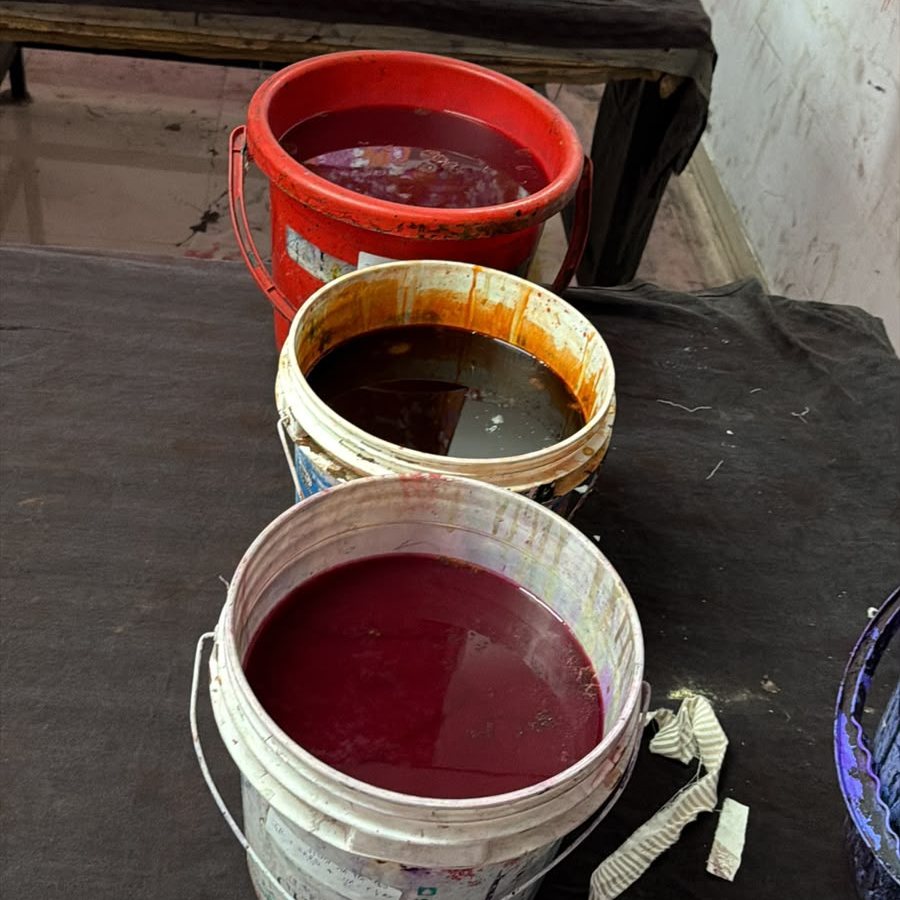
Natural dyes come from plants and minerals. In Bagru, near Jaipur, printers still use a small set that has hardly changed in centuries:
- Indigo for blues, from the indigo plant
- Madder root for reds and pinks
- Harda, the dried fruit of the myrobalan tree, which gives a yellow base and helps other colours bind
- Geru, a red earth, for warm terracotta tones
- Black made by fermenting scrap iron with jaggery
Bagru is also home to dabu, a resist made from clay, gum and lime. It is printed onto the cloth first, then the fabric goes into the indigo vat, and the covered areas stay pale. The soft, slightly cracked lines you see on dabu prints come from that mud drying and breaking.
Our Bagru range is printed entirely with natural, vegetable dyes. The rest of our range uses AZO-free dyes, and our indigo pieces are dyed in indigo.
How the two compare
Natural dyes give deep, muted colours that soften with age and sit well in rustic, coastal and slow living interiors. They vary a little from batch to batch, which suits a handmade story but means a reorder will not match the first lot exactly. They also need gentler care.
AZO-free synthetic dyes give a much wider range of colours, including clean whites with crisp prints, and they repeat closely from order to order. If your customers expect a reorder to match the photo on your website, this is the safer choice.
Many shops stock both: a natural dye story for the core of the range, and AZO-free prints for brighter, seasonal designs.
Testing: what to ask for
For the EU and UK, ask for an AZO test report from an independent, accredited lab for your order. For larger programmes, buyers often add colour fastness tests too, which show how a fabric holds its colour:
- to washing (ISO 105 C06)
- to rubbing, dry and wet (ISO 105 X12)
- to light (ISO 105 B02)
Natural dyes usually score a little lower on rubbing and light than synthetic ones. That is normal, and a good supplier will tell you up front rather than let you discover it at the lab. We arrange independent testing per order and include the cost in the quotation.
What you can and cannot claim
Be careful with words on your labels and product pages. “Hand block printed” and “AZO-free” are fine when they are true and you can back them up. “Natural dyes” should only be used for pieces actually dyed with natural dyes, not for a whole range. “Organic” is the one to watch most: in the EU, UK and US, buyers and regulators read “organic cotton” as certified organic, usually under GOTS. Do not use it unless the product carries that certification.
Caring for naturally dyed cotton
A short care note on your tag saves a lot of returns. For naturally dyed and indigo pieces we suggest:
- wash separately for the first few washes, cold, with a mild detergent
- avoid bleach and strong optical brighteners
- dry in the shade, since strong sun fades natural colours
- iron on the reverse
Some colour may run in the first wash with indigo. That is expected, and it settles after a few washes.
Working with us
If you want a natural dye range, an AZO-free range or a mix of both, tell us what you need and which market you sell in. You can also request our trade catalogue or read the buyer FAQ.
More for buyers: all buyer guides, the buyer FAQ and our trade catalogue.