
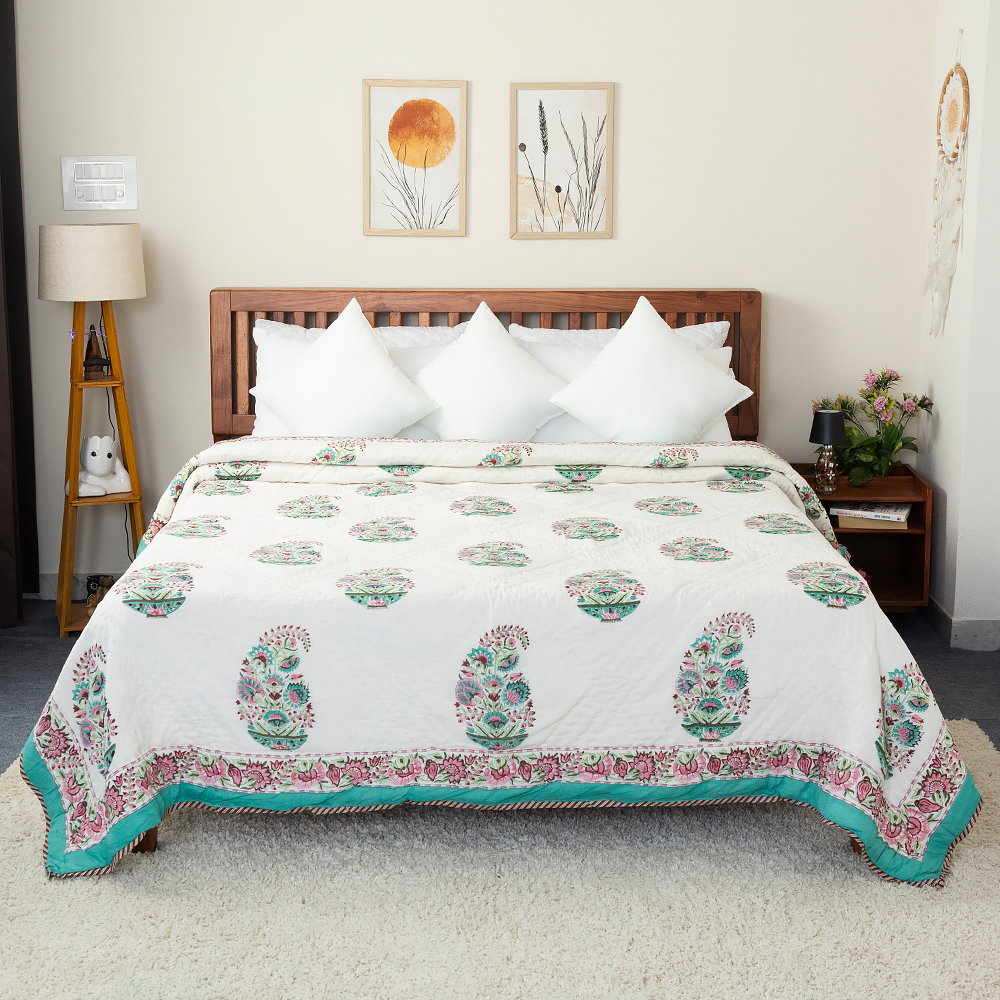
The most common reason a first bedding order from India goes wrong is not the print or the fabric. It is the size. “King” means five different sizes in five markets, a “standard” pillowcase is different almost everywhere, and Indian workshops naturally default to Indian sizes. This guide shows how bed sizes differ across the main export markets, where Indian made bedding fits, and how to write a size spec that protects you.
Same name, different size
Mattress sizes in centimetres, width x length:
| Name | UK | USA | Germany | Australia | UAE |
|---|---|---|---|---|---|
| Single | 90 x 190 | 99 x 191 (Twin) | 90 x 200 | 91 x 190 | 90 x 190 |
| Double | 135 x 190 | 137 x 191 (Full) | 140 x 200 | 137 x 190 | 120 x 190 |
| Queen | not used | 152 x 203 | not used | 152 x 203 | 160 x 200 |
| King | 150 x 200 | 193 x 203 | 180 x 200 | 182 x 203 | 180 x 200 |
A UK king is 150 cm wide. A UAE or German king is 180 cm and an American king is 193 cm. So a purchase order that just says “king” is an invitation to a costly mistake. Always write the size in centimetres.
Fitted sheets have one more trap: mattress depth. UK and US fitted sheets usually allow about 30 to 38 cm, while Australian and many UAE mattresses need 40 to 50 cm walls. A sheet that fits a London bed will not fit a Sydney one.
Pillowcases are different everywhere
| Market | Standard pillowcase (cm) |
|---|---|
| UK | 50 x 75 (housewife) |
| USA | 51 x 66 (standard) |
| Germany | 80 x 80 |
| Australia | 48 x 73 |
| UAE | 50 x 90 |
The one size that travels well is the 65 x 65 cm square, sold as Continental in the UK, a square pillowcase in France and a Euro sham in the US.
Sheets or duvet covers?
The UK, US, Australia and the UAE all use flat and fitted sheets. Germany, the Netherlands and much of continental Europe mostly sleep under a duvet with a cover and rarely use a top sheet, so a sheet set range will struggle there. Duvet covers also follow local duvet sizes, for example 200 x 200 cm or 230 x 220 cm in the UK and 135 x 200 cm or 200 x 200 cm in Germany.
Where Indian made bedding fits
Hand block printed bedding from Jaipur is usually made in a few traditional sizes, and they map onto Western categories better than you might think, as long as you name them right:
- Our bedsheets are 108 x 108 inches (274 x 274 cm), a generous flat sheet that tucks in well on most queen and king beds.
- Our bedcovers, quilts and comforters are 90 x 108 inches (229 x 274 cm). In Western terms that is a coverlet or bedspread, laid over the bed and hanging down the sides. It works well in that role, but it is not a duvet cover, so do not sell it as one.
- Our dohars are 60 x 90 inches (152 x 229 cm), a light summer blanket that also works as an oversized throw.
- Our throws are 50 x 70 inches (127 x 178 cm). A typical American throw is 50 x 60 inches, so ours is a little longer, which suits end of bed styling.
Any of these can be made in other sizes, including market specific fitted sheets, duvet covers and pillowcases, if you give us the measurements.
How to write a size spec that protects you
A few habits prevent almost every size problem:
- Give a finished size table in centimetres, with inches alongside, for every item in the set, including pillowcases.
- State a tolerance, for example plus or minus 1 cm on stitched items and a little more on hand quilted ones.
- Ask for pre-shrunk fabric or allowance for shrinkage. Cotton can shrink a few percent in the first wash, so agree a maximum, often 3%.
- Approve a size sample before bulk production, and measure it yourself.
- Label sizes the way your market expects. The US wants inches first with metric alongside, while the EU and UK want centimetres as the main unit.
Working with us
Tell us which market you sell in and the bed sizes you need, and we will confirm what we can make and quote by size. You can send us an enquiry, request the trade catalogue or read the buyer FAQ.
More for buyers: all buyer guides, the buyer FAQ and our trade catalogue.